
The Real Cost of an Oversized Cash Buffer
Cash feels safe. There's no volatility to stomach, no headlines to worry about, and you can see the balance sitting right there whenever you check your account. So it's no surprise that many of the successful, disciplined savers we work with at Beacon Financial Strategies tend to accumulate more cash than they actually need — sometimes far more.
We understand the instinct. But as a an advisor, part of our job is to help clients see the trade-offs that aren't obvious at first glance. And an oversized cash position is one of the most common — and most expensive — blind spots we see, particularly among clients in their 50s and 60s who have worked hard to build a financial cushion.
What Counts as an "Oversized" Cash Buffer?
A healthy emergency fund is a cornerstone of any sound financial plan. For most households, that means three to six months of essential expenses in an easily accessible account — sometimes closer to twelve months for those with variable income, business owners, or those nearing retirement.
An oversized cash buffer is anything meaningfully beyond that target — money that isn't earmarked for a near-term purchase or a specific short-term goal, but is simply sitting in a checking, savings, or money market account "just in case."
We occasionally meet with prospects or even clients who maintain cash well beyond what their situation calls for. It often stems from a windfall, a home sale, a bonus, or simply a longstanding discomfort with market volatility. Whatever the source, the cost of leaving that money uninvested over the long run can be significant.
Quantifying the Opportunity Cost
To illustrate the impact, let's look at a simple example: $250,000 in excess cash — money beyond a reasonable emergency fund — left in a savings or money market account earning roughly 3% versus that same amount invested in a diversified portfolio with a long-term average return of roughly 6%.
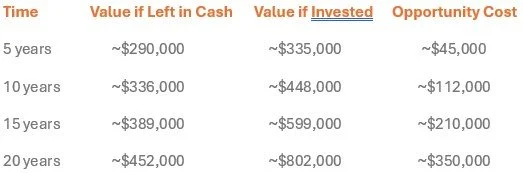
This table shows the difference between $250,000 kept in cash earning 3% and the same amount invested in a diversified portfolio earning 6%.
(These figures are illustrative only, based on hypothetical average annual returns of 3% for cash and 6% for a diversified investment portfolio. They do not represent any specific investment, are not guaranteed, and actual results will vary. Past performance is not indicative of future results.)
A few things stand out:
The gap compounds. In year five, the difference is meaningful but manageable. By year twenty, it has grown to $350,000 — money that could have funded years of retirement income, a legacy for children or grandchildren, or a more flexible lifestyle.
Time in the market is doing the heavy lifting. The longer the money sits uninvested, the more growth is permanently forfeited — not because of a single bad decision, but because of years of missed compounding.
This is the "quiet" cost. Unlike a market downturn, there's no single moment where this cost is visible. It never shows up as a loss on a statement — it simply shows up as a lower number than it could have been, years down the road.
Inflation Adds Another Layer
Even in a favorable environment where cash yields roughly keep pace with inflation, "keeping pace" is very different from "getting ahead." At a 3% inflation rate, cash earning 3% simply preserves today's purchasing power twenty years from now — it doesn't grow it. Meanwhile, the invested dollars in our example are working toward real, long-term growth on top of inflation.
In other words, an oversized cash position isn't a neutral, risk-free choice. It's a decision that carries its own risk — the risk of standing still while your long-term goals move further away.
Why Clients End Up Here
In our experience working with clients, a few patterns show up again and again:
A liquidity event without a plan. A business sale, inheritance, or retirement plan rollover creates a large cash balance, and without a clear reinvestment plan, it simply sits.
Lingering caution from a past market downturn. Clients who experienced anguish from a significant market downturn sometimes keep extra cash as an emotional buffer, even after their financial capacity to take on risk has returned.
Fear of poor timing. No one wants to invest their hard-earned cash right before a severe market downturn. Sometimes the fear of investing during a period of time when 1) market pundits are promoting fear 2) valuations seem higher than normal, or 3) markets are at an all-time high - cause investors to delay investing.
Uncertainty about what the money is "for." Without a clear picture of short-term needs versus long-term goals, it's hard to know how much should stay liquid and how much should be put to work.
Simply not getting around to it. Life is busy, and moving a large sum of money can feel like a project that keeps getting pushed to next month.
None of these reasons are irrational — they're deeply human. But they're also exactly the kind of blind spot that a second set of eyes, and a comprehensive financial plan, is designed to catch and address.
Finding the Right Balance
The goal isn't to eliminate cash — it's to right-size it. A well-built financial plan should account for:
A clearly defined emergency fund, sized to your specific situation, income stability, and upcoming obligations
Known short-term expenses (a home renovation, a wedding, a car purchase) held in cash or cash-equivalents
A tax-efficient investment strategy for the remainder, aligned with your time horizon and long-term goals
Periodic check-ins to reassess your cash position as life changes — a new job, retirement, or a shifting risk tolerance
This is where comprehensive planning matters. It's not just about picking investments — it's about understanding your full financial picture well enough to know how much cash actually serves you, and how much is quietly working against you.
The Bottom Line
Cash plays an important role in every financial plan — but more isn't always safer. An oversized cash buffer can feel prudent while, in reality, it may be one of the more expensive decisions in your financial life, simply because the cost is invisible day to day and only becomes clear when you look years down the road.
If you're unsure whether your cash position is helping or hurting your long-term plan, feel free to reach out to Beacon, that's exactly the kind of question we can help you think through.
This article is for educational purposes only and does not constitute investment, tax, or legal advice. It does not take into account your specific financial situation, objectives, or risk tolerance, and should not be relied upon as the sole basis for any financial decision. Hypothetical figures are illustrative only and are not guarantees of future performance. Please consult with a qualified financial advisor, tax professional, or attorney regarding your individual circumstances. Beacon Financial Strategies is a fee-only, fiduciary registered investment advisor based in Raleigh, North Carolina.

Chip Hymiller, AIF®, CFP®
Founder and Principal
Find out more about Chip on his profile page here! Be sure to listen to his episode on Finance in a Flash to hear how he started in the Financial Planning Industry!