
Understanding Annuities: The Three Main Types
Annuities show up in a lot of retirement conversations, but they remain one of the most misunderstood products in personal finance. Part of the confusion is that an “annuity” isn’t one product, but a family of related products that can look very different from contract to contract.
What Is an Annuity?
An annuity is a contract between an individual and an insurance company. At their essence, annuities are financial tools that are used to transfer risk (longevity risk and/or investment risk) from individuals to an insurance company. Therefore, it is extremely important for those who are considering an annuity of any kind to also thoroughly vet the strength of the insurance company!
Understanding the Three Categories of Annuities
There are three broad types of annuities including immediate, fixed, and variable annuities.
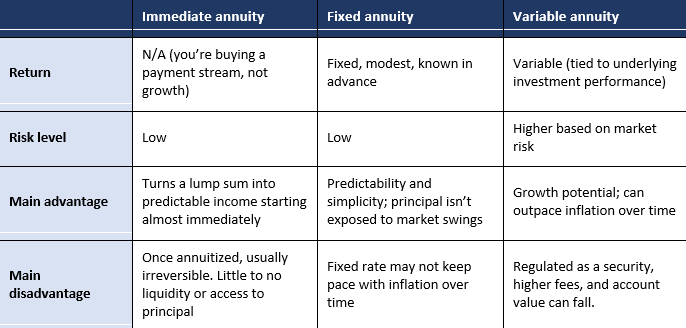
An immediate annuity begins paying out to the annuitant (typically the same person as the policy owner) right away. There is no accumulation phase, but it must be purchased up-front with a lump sum payment. It can be viewed as a private pension, since the payments are guaranteed for the duration of the contract.
A fixed annuity guarantees a set interest rate for a specified period, making it low-risk (but not FDIC insured), with modest and predictable returns. There is an accumulation phase that varies by contract (some may last just a few years, while others extend to longer terms). In essence, fixed annuities are similar to bonds in that they provide stable income.
A variable annuity invests your money in sub-accounts similar to mutual funds, so its value rises and falls with the financial markets. Variable annuities grow tax-deferred and are taxed only when withdrawn. Unlike immediate and fixed annuities, the possible payout from a variable annuity can change based on how the underlying investments perform. Often times, variable annuities can have various “riders” that can provide certain guarantees that can serve to protect investors from various unknowns - things like market declines or withdrawal rates. Of course, any “guarantees” offered in annuity contracts increase the ongoing cost of the annuity.
Below is a quick summary of the differences, advantages, and drawbacks of the three main types of annuities:
The Bottom Line
An annuity isn’t one product, but rather a family or category of insurance contracts structured with the purpose of transferring various types of risks from an individual to an insurance company. Because annuities are complex, long-term and often irreversible, understanding these distinctions is essential before implementing an investment or financial planning strategy utilizing annuities.

Isaac Elsasser
Client Service Administrator
Find out more about Isaac on his profile page here! Be sure to listen to his episode on Finance in a Flash to hear how he ended up at Beacon Financial Strategies!