
2026 Numbers to Know
The IRS has announced contribution savings limits for retirement savings accounts for 2026. Make sure you let your payroll department know that you want to increase your contributions to these plans.
The maximum amount employees can contribute to a 401(k) plan will increase to $24,500 in 2026 (up from $23,500 in 2025). If you're age 50 or older, you can also make catch-up contributions of up to $8,000 to these plans in 2026. In addition, employees age 60, 61, 62, and 63 (on 12/31/2026) can now make a larger catch up contribution in the total amount of $11,250. Here is what else you need to know
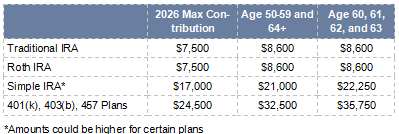
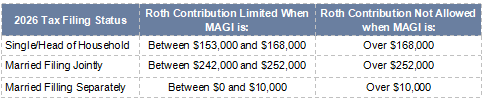
More taxpayers are eligible to make Roth IRA contributions due to the fact that the income limitations are rising. If your filing status is single or head of household, you can contribute the full $7,500 ($8,600 if you are age 50 or older) to a Roth IRA if your Modified Adjusted Gross Income (MAGI) is $153,000 or less (up from $150,000 in 2025). And if you are married and filing a joint return, you can make a full contribution if your MAGI is $242,000 or less (up from $236,000 in 2025). Just keep in mind that contributions cannot exceed 100% of your earned income. The following chart shows the income phaseout for Roth IRA contributions in 2026:
There are a few other updates for 2026 that are worth noting:
The wage limit for Social Security tax has increased to $184,500 (from $176,100 in 2025). So, until an employee reaches $184,500 in wages, their employer has to withhold the 6.2% of Social Security taxes from wages.
Health Savings Account contribution limits are $8,750 for a family plan and $4,400 for an individual plan. There is also a $1,000 catch-up available for those 55 and over.
The annual gift tax exclusion remains $19,000 per donee.
So, as we head into 2026, make sure you double check (and increase) your retirement plan contributions with your employer. And don’t forget to save to your IRA and Roth IRA if you are eligible to do so. Give our office a call if you have questions on how best to save for your retirement goals.