
If you've recently enrolled in Medicare — or you're approaching age 65 — you may have noticed a surprising line item on your premium statement: an extra charge tacked onto your Part B or Part D premium. This isn't a billing error. It's called IRMAA, and if you're a higher-income retiree, it's worth understanding well before you turn 65.
Read MoreIf you've reviewed a retirement projection with us, you've probably seen a number like "87% probability of success." That number comes from a Monte Carlo simulation — one of the most useful tools in retirement planning, and also one that can be misunderstood. Here's what it actually does, what that percentage really means, and — just as important — what it can't tell you.

Read MoreThinking about a Roth conversion? In this quick video, Erin breaks down what a Roth conversion is, when it might be a smart move, and what to keep in mind before taking the leap. Whether you're just getting started or ready to dig into the details, we've got you covered.
Read MoreThe SECURE Act eliminated the stretch IRA for most beneficiaries. We break down the new 10-year rule and what it means for your estate plan. If you expect to inherit an IRA — or you're the one naming beneficiaries on your own account — this is worth understanding now, while there's still time to plan around it.
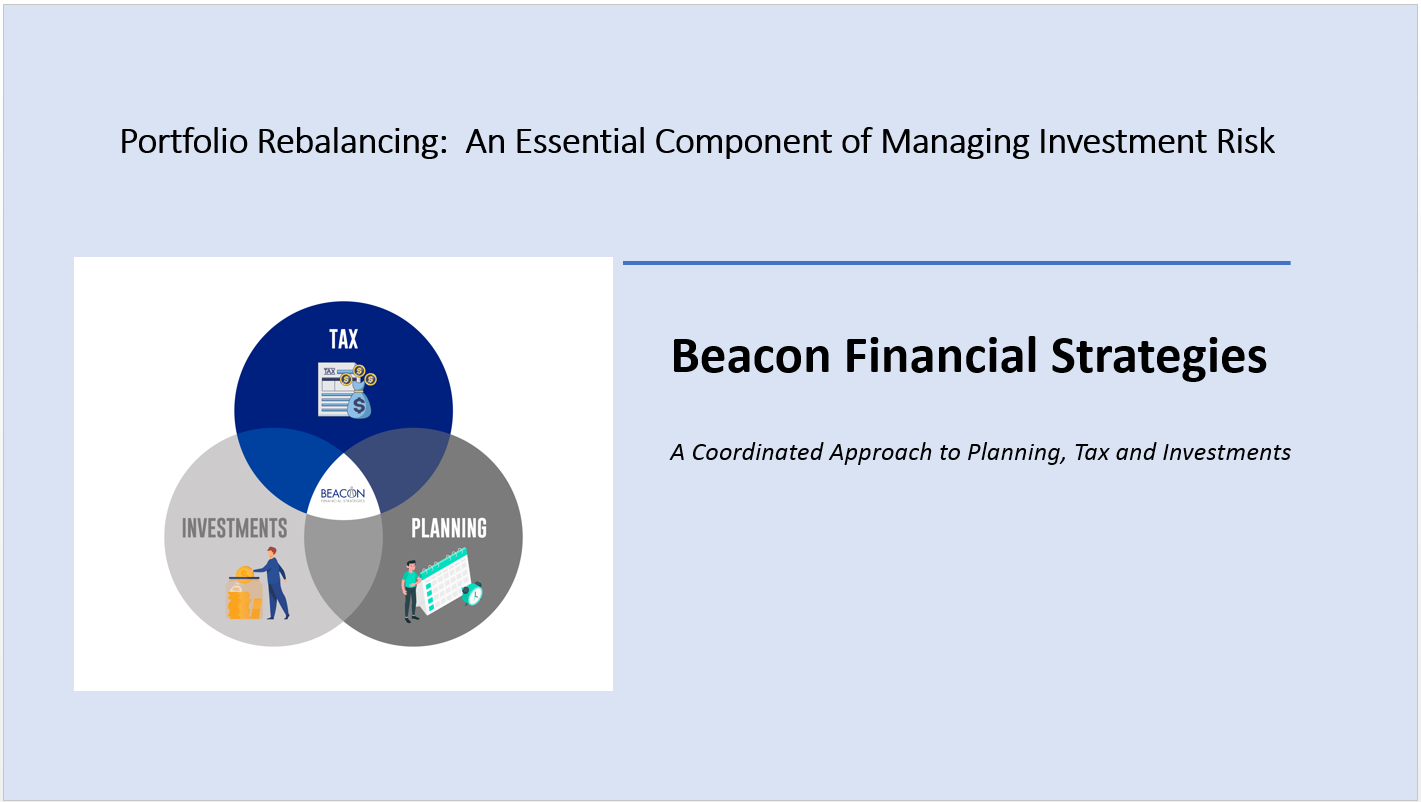
Read MoreWe at Beacon Financial Strategies believe that rebalancing is an integral component of the investment management process. In this presentation, Chip Hymiller, AIF®,CFP® explains the concept of rebalancing and discusses the advantages of implementing a portfolio rebalancing strategy.
Read MoreYou worked hard, saved well, and now you are stepping into retirement. This transition from accumulation to the distribution phase of life can be stressful. It is important we maximize the amount of money available for us to spend and one of the most important ways we do that is through making efficient decisions on which investment account type we take withdrawals from and when.
Read MoreIn this episode of Finance in a Flash: Plain Talk, we wrap up our three-part series on unemployment data by zooming out to the bigger picture—what the jobs report really tells us about the economy. Using the latest data from early 2026, we break down the relationship between employment and GDP, explain why job growth can lag behind economic growth, and explore how trends like artificial intelligence and productivity gains may be reshaping the labor market.
Read MoreIn this episode of Finance in a Flash: Plain Talk, we continue our mini-series on unemployment data by diving into the latest report from the Bureau of Labor Statistics. Using February 2026 data, we break down what the unemployment rate actually measures, why headline job numbers can be misleading, and how key factors like labor force participation and population growth shape the broader economic picture.
Read MoreOn this episode of Finance in a Flash – Plain Talk, John and Dave kick off a three-part series breaking down one of the most talked-about economic topics: Unemployment. They start the series off discussing ADP Employment Report, explaining what it is, how it differs from government data, and why it often tells a slightly different story than the headlines you see on Friday mornings.
Read MoreOn this episode of Finance In A Flash, John interviews Beacon's newest team member, Isaac Elsasser. We really hope you enjoy this episode and get to know more about Isaac as he talks about his personal life, how he got into financial planning, and his time here at Beacon so far!
Read MoreIf you’re an investor age 50 or older planning to make “catch-up” contributions to a retirement plan, 2026 brings several important changes to understand. These include updated contribution limits and a new mandatory Roth catch-up rule for high-income earners that could affect both your taxes and your take-home pay.
Read More
The IRS has announced contribution savings limits for retirement savings accounts for 2026. Make sure you let your payroll department know that you want to increase your contributions to these plans.
Read More
One of the more useful provisions of the Secure Act 2.0 gives those who have unused 529 plan balances the option of rolling over funds with no tax implications into a Roth IRA. Here are the key rules for rolling over funds from a 529 plan to a Roth IRA.
Read MoreWhen someone asks how you are doing, how do you usually respond? More importantly, do you feel like you’re truly living your best life? Do you feel as though you are thriving?
Read MoreRetiring before age 65 can feel exciting, but it also raises an important question: how will you cover health insurance until Medicare begins? Fortunately, there are several paths to consider.
Read MoreAt Beacon Financial Strategies, we agree that investments that generate income should be a valuable component of most retiree’s portfolios. However, we also believe that maintaining a diversified investment approach will enhance returns and reduce risk for most long term investors. This really proves beneficial during the distribution phase of your life as it provides for income, growth, potential tax efficiency, and flexibility as life changes.
Read MoreJoin us for an informative session on the recently signed 2025 tax law and its impact on individuals and families. We’ll cover new provisions, changes to existing rules, and rules that are eliminated. This webinar will help you understand how the new law may affect your taxes and what that means for your financial planning moving forward.
Read MoreLet’s face it, seniors today have access to improved medical care and are healthier, more active and are likely to have longer lives. So what are the financial implications for retirees who will likely live well into their 80s and possibly their 90s?
Read MoreEmployer-sponsored retirement plans such as 401(k)s are some of the most powerful retirement savings tools available. If your employer offers such a plan, we would strongly recommend you consider participating.
Read More
The principles of efficiency, consistency, and composure bind swimming and financial success together. In both, it’s not about how hard you work, but how smartly you move forward.
Read More